
Why Do We Care So Much About Virtue, Anyway?
It's one of those things that seems really obvious, but isn't

Sometimes there are philosophical concepts that seem completely obvious, but are actually quite difficult to pin down. Goodness is one of those concepts. It’s just one of those things that seems like it should require no explanation—if you think of yourself as even a remotely good person, then you know what being a good person is, and, therefore, you know what makes a person good, and, thus, you know good-ness itself. Or, to call it by its other, more philosophical name, virtue ought not to be unknown to the good (virtuous) person.
Of course, as it turns out with everything philosophical, none of this is, in fact, obvious. Or at least the ancient philosophers had much to say on this topic.
I recently revisited Plato’s Meno, which I remembered as a short but somehow geometry-heavy dialogue when I was sprinting through it in graduate school trying to get ready for my qualifying exam. Unsurprisingly, it was much better on the slower reread.
In this dialogue, Socrates and his interlocutor, Meno, discuss what arete is. Arete is a Greek word that is usually translated as “virtue,” and means something like “excellence.” (For the sake of ease, I will refer to the term in English as “virtue.”)
Meno: Can you tell me, Socrates, whether virtue is teachable? Or is it not teachable, but something you can acquire? Or can it neither be acquired nor learned, but is it actually something that people have by nature, or in some other way?
Μένων: ἔχεις μοι εἰπεῖν, ὦ Σώκρατες, ἆρα διδακτὸν ἡ ἀρετή; ἢ οὐ διδακτὸν ἀλλ᾽ ἀσκητόν; ἢ οὔτε ἀσκητὸν οὔτε μαθητόν, ἀλλὰ φύσει παραγίγνεται τοῖς ἀνθρώποις ἢ ἄλλῳ τινὶ τρόπῳ;
Socrates laughs and lightly chides Meno for asking such a question, supposing that he has been inspired by accounts of the sophist Gorgias, who went from town to town and claimed that he could answer any question put to him, giving everyone a rapacious appetite for this particular kind of performative “wisdom.”
Aside for my new readers: you might see a certain similarity between the term sophist and the term philosopher, as the root “sophos” (meaning “wisdom”) is in both words. A sophist was someone who was essentially a very skilled rhetorician and claimed that they could teach someone things like virtue, or argue on any point and win, or make lesser arguments stronger, and so on. The philosopher is far more difficult to define.
The philosopher answers in classic Socrates style: “So far am I from knowing whether it can be taught or not that I don’t even happen to know what virtue is at all,” he says,” (ἐγὼ δὲ τοσοῦτον δέω εἴτε διδακτὸν εἴτε μὴ διδακτὸν εἰδέναι, ὥστ᾽ οὐδὲ αὐτὸ ὅτι ποτ᾽ ἐστὶ τὸ παράπαν ἀρετὴ τυγχάνω εἰδώς).
There starts the dialogue in earnest: before you can say anything about something, you have to know what that something is.
Socrates and Meno do their best to define virtue together. Meno puts forward a rudimentary definition based on various roles in life: a virtuous man is a good citizen, a virtuous woman is a good homemaker, a virtuous child obeys his parents, and so on. Socrates pushes back: if we agree that things like prudence, justice, kindness, etc. are characteristic of virtue, does this mean that virtue is not one thing, but many things? Are these things we count as virtuous, such as justice or honesty, the same thing as virtue itself?
This line of inquiry sparks other questions as well: can cultural, literary, and mythological heroes serve as examples of virtue? It’s not always clear that there is overlap between actions one could deem heroic and actual virtue.
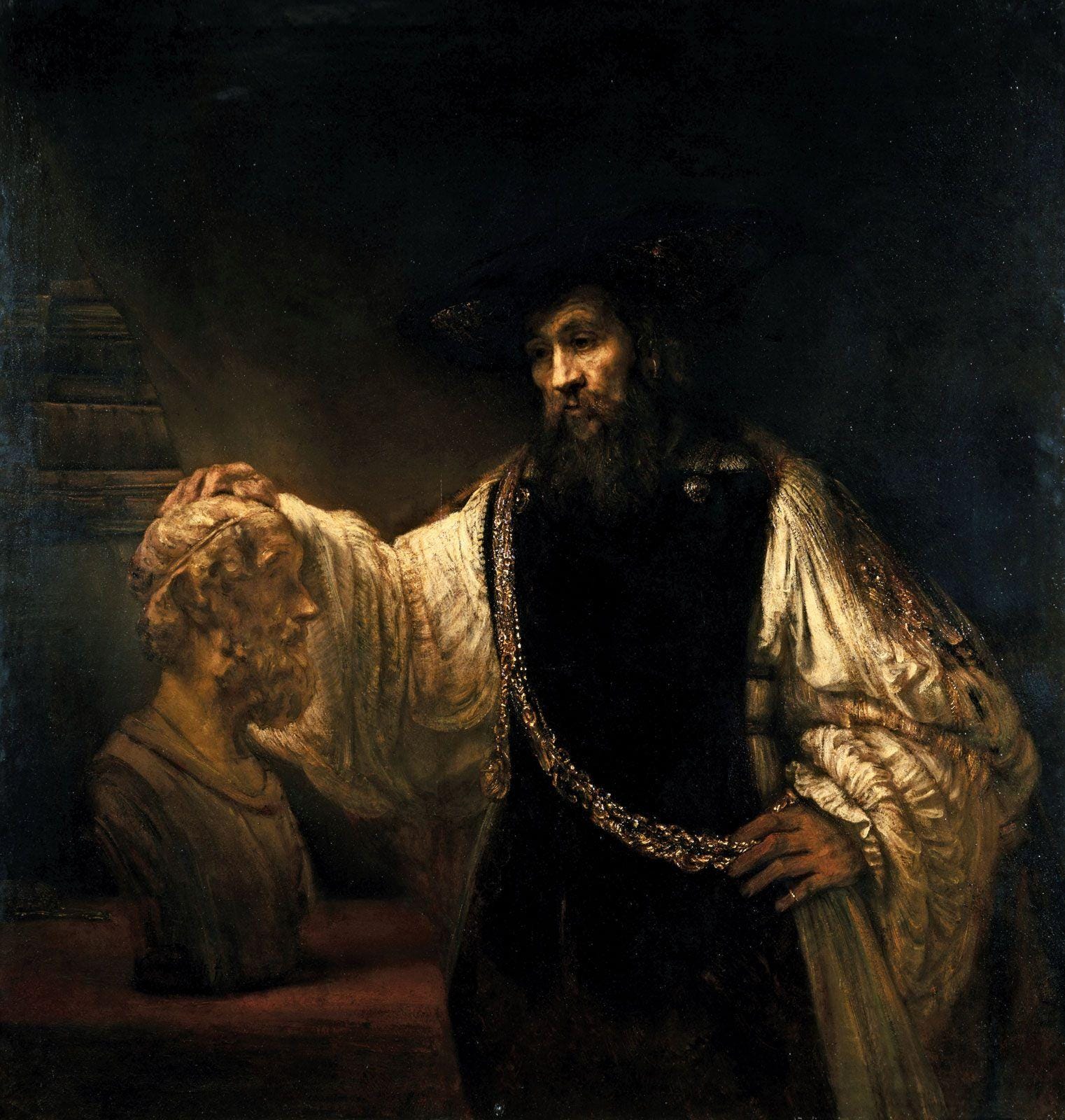
Returning to Plato - the rest of Meno is quite a fascinating journey that ends in aporia: they weren’t able to define virtue, but they know more about it than they did before they started discussing it.
In the post-Plato world of philosophy, there came more philosophical discussion around what exactly is the telos, or ultimate “goal,” of existence. According to Aristotle, the telos of any given thing is something like fulfilling its essential purpose. In the case of humans, who have a distinctive capacity for reasoning, a good life is to attain eudaimonia, which is like a kind of blessed happiness and prosperity.
The Stoics drilled down more on the question of virtue. According to Stoic philosophy, the only good thing is virtue, and the only bad thing is vice. Everything else is ambiguous. Now, Aristotle put a lot of things under the umbrella of eudaimonia, to which virtue and its various forms contributes a great deal: there are moral virtues and intellectual virtues and political virtues and so on. But for a Stoic it’s more straightforward: the telos is virtue.
Now, an Epicurean would come along and ask what the real purpose of virtue is, and one possible answer is that, when we live virtuously, we achieve true happiness—thus, because virtue would be useless if it did not have this effect, we can say that pleasure (defined by the Epicureans as a lack of pain and suffering) is the telos. You can see how this line of thinking can be situated alongside Plato and Aristotle, and in opposition to the Stoics. (Others have gotten into the nitty gritty of philosophical argumentation far more thoroughly and eloquently than I, of course).
All this raises today’s central question: why is it that we care so much about virtue, anyway? A Stoic might suggest that goodness is good for its own sake. An Epicurean would argue that it leads us to pleasure—if “virtue” makes us miserable, it’s not actually good or useful to us. I think one way of rationalizing all this, at least in part, is that love and compassion combined with wisdom make a powerful team. In this regard, I think Aristotle’s more expansive discussion of human flourishing, driven by the cultivation of virtue(s), is compelling.
Of course, real-life scenarios complicate this. What about those times when we mean well, but things turn out badly? Or what about when we make a righteous decision at the expense of our own happiness? Not everything that seems like virtue is virtue in actual fact.
There are no easy answers. If Socrates couldn’t avoid aporia, why should we be able to? From my own perspective, I think that one way of thinking about virtue is asking myself whether something brings us closer to or further away from God. Others will have other inklings to follow. I do think that one reason why the matter of virtue may seem obvious at first is that, on some level, we do need parameters and definition: we cannot each define virtue for our own selves, even as virtue seems to be expressed specifically for each unique circumstance. This also requires some re-definition of things like flourishing: it’s not about money or status or power, or really anything material, but something deeper.
The transition from classical to Christian thought allowed such questions to take on new ethical and spiritual dimensions. Think of Boethius, concerned with the consolation that philosophy offers to the suffering. Part of his solution is that God is, essentially, the one who has the most absolute and sublime virtue, who possesses an omnipotence and wisdom in which humans do not and cannot share.
As I wrote on a couple months back, I think aporia is underrated; we should be more comfortable with not knowing everything, immediately, right this minute. I’m happy to admit that, like Meno, I don’t know in exact terms what virtue is or why it is so important. But at the same time, I also feel strongly that we can and should nurture our capacities to recognize virtue when we see it; perhaps virtue cannot be precisely defined because of the uniqueness of the things that happen in our lives. When correctly honed, our intuition (that sense connecting us to divine wisdom) tells us what is virtuous and what is not. Sure, humans have a great capacity to lie to themselves, but if we could employ our judgment under ideal conditions, then I think there is that element of “you know it when you see it.”
So, why do we care about virtue so much? There are many ways to answer. I’ll leave you with one of my impressions, which is that contemplating virtue inspires us to reach our highest potential, not defined in human terms, but in divine ones. To cultivate virtue is to no longer be reliant on worldly successes, but to aim at higher things.
What do you think? I can never decide what school of ancient philosophy I’d adhere to if I lived in the Greco-Roman world, largely because of these kinds of debates!
Take care until next time,
MKA
I really enjoyed your article.
It clicks for me today especially since I just watched Gladiator again last night after many years.
We care about virtue because virtues have real effect in the world - virtue is the creation of goodness itself both for ourselves and the people around us.
And the lack of virtue would create a man such as Commodus who would "butcher the whole world if you would only love me".
I think one could also think of small acts as virtuous, something simple like making one's bed, doing the dishes.
If you don't do those things, you leave a mess for your future self and for others.
So to do it is a kind of virtue.
Putting it into concrete acts brings it out of the philosophical realm and into our lives.
Its good to both think of these things as well as do them.
Learning of virtue itself is a virtue because it gives us the foundation to put it into action, like a roadmap.
Virtue is necessary both to create goodness and to prevent evil things from taking place. It should not remain only in books and philosophical thoughts.
Great essay! A tour de force on ancient western philosophy and the search for the meaning of virtue.
I’m surprised, though, that you didn’t mention that the word “virtue” itself derives from the Latin word “vir”, meaning man or manliness, with connotations of “manliness” and bravery. This the entomological history of that term.
That said, to me, virtue is a reflection of what God is:perfect goodness. The ancient Greeks and Romans had no concept Biblical Monotheism, so that meaning is absent from their understanding of it.
Post Enlightenment skeptics and more modern determinist philosophers struggle to define virtue without a belief in the absolute. They end up where they began.
Just a thought.
Have a pleasant day.