
The Philosopher: A Stereotype as Old as Time
In the Roman Imperial era, philosophy was not just an intellectual discipline. Philosophers were larger-than-life figures, to the point that they were also stereotypes or clichés.

We all know what a philosopher is.
Or do we?
The word “philosopher” is made up of two simple roots (love + wisdom), but, even beginning in antiquity itself, the word is so much more complicated than a simple definition of “lover of wisdom” could ever convey.
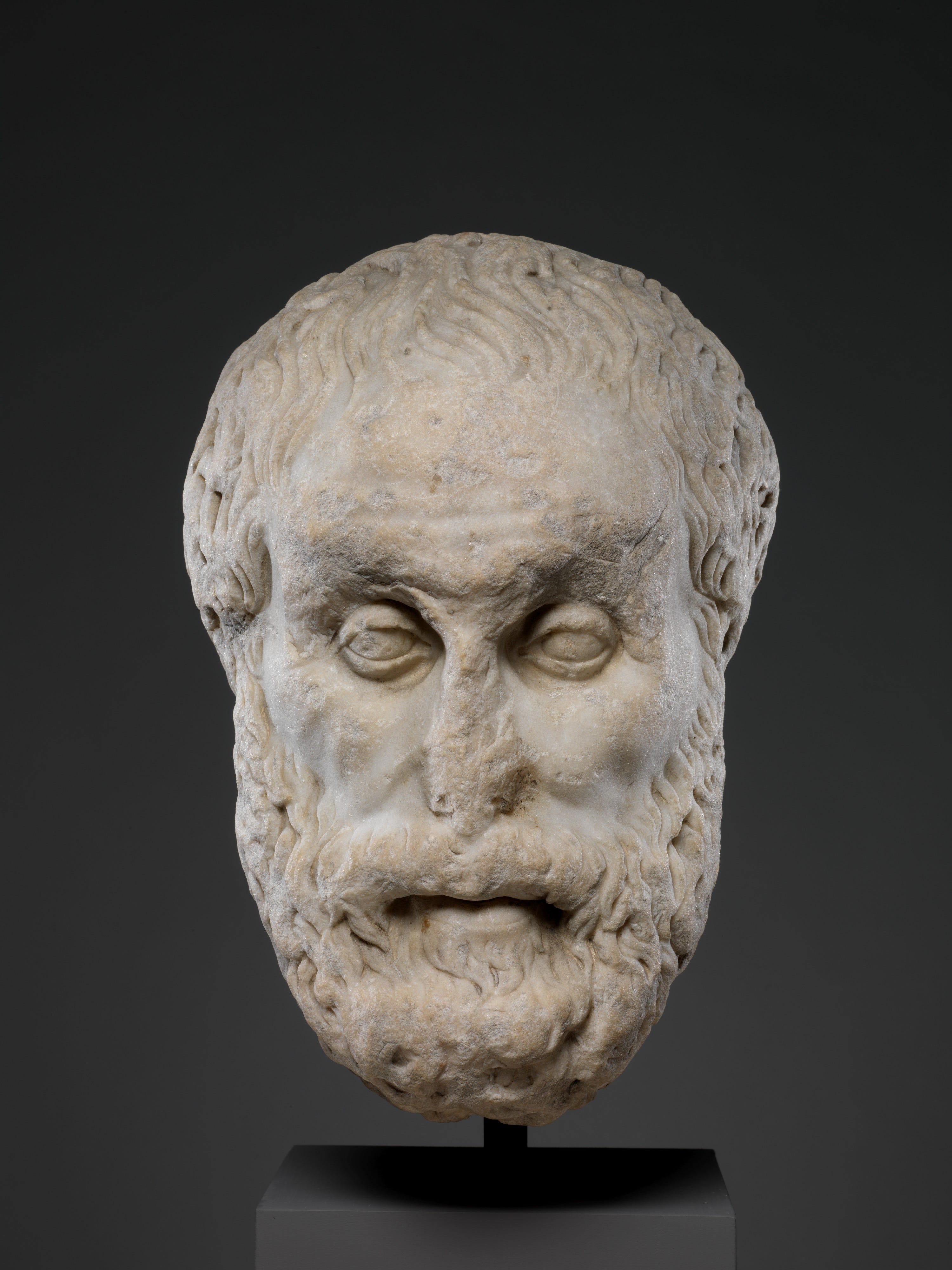
In antiquity, the term was reserved for those who, in some sense, cultivated what I think can best be described as a personal brand centered around the creation and dissemination of knowledge. This is just my opinion, of course; there are other ways to envision philosophers, and I don’t mean to suggest that this is the only way of thinking through these things. I have no doubt that, even today, there are countless people who lived/live in complete obscurity, who will never publish their work or be known outside their immediate circles, yet who are true sages.
Speaking of the sage, that was another categorization closely related to that of the philosopher: there are legends of numerous figures such as Solon or even King Nestor who were not necessarily philosophers, but possessed vast amounts of wisdom. In the case of Solon, it’s not even that he wasn’t a philosopher, it’s just there’s something that makes him a bit different from the likes of Aristotle or Seneca. He was a “wise man,” not necessarily belonging to any particular school or having a signature theory of the way things are.
It’s a bit like the old philosophical cliché about the tree falling in the woods. If nobody is around to observe you being a real philosopher, do you really exist as such?
I would contend that, to the Romans at any rate, the answer to this is no.
Instead, identity as “philosopher” existed at the intersection of a certain way of life, a certain amount of public recognition of those daily activities, and one’s own intention to produce philosophical ideas and impart them to others, either via text or via teaching.
The organization of philosophies into schools—not a practice unique to the Greeks and Romans, obviously—further heightens this tension between what should be an internal, private thing (being a philosopher) and what turns into a very public, external one (having that identity legitimized by the public).
I’m fond of saying that philosophy was a pop culture phenomenon in the Roman period as much as it was an academic discipline. During this period, there was a kind of “stereotypical” view of the philosopher, the philosophical lifestyle, and even the appearance of a philosopher.
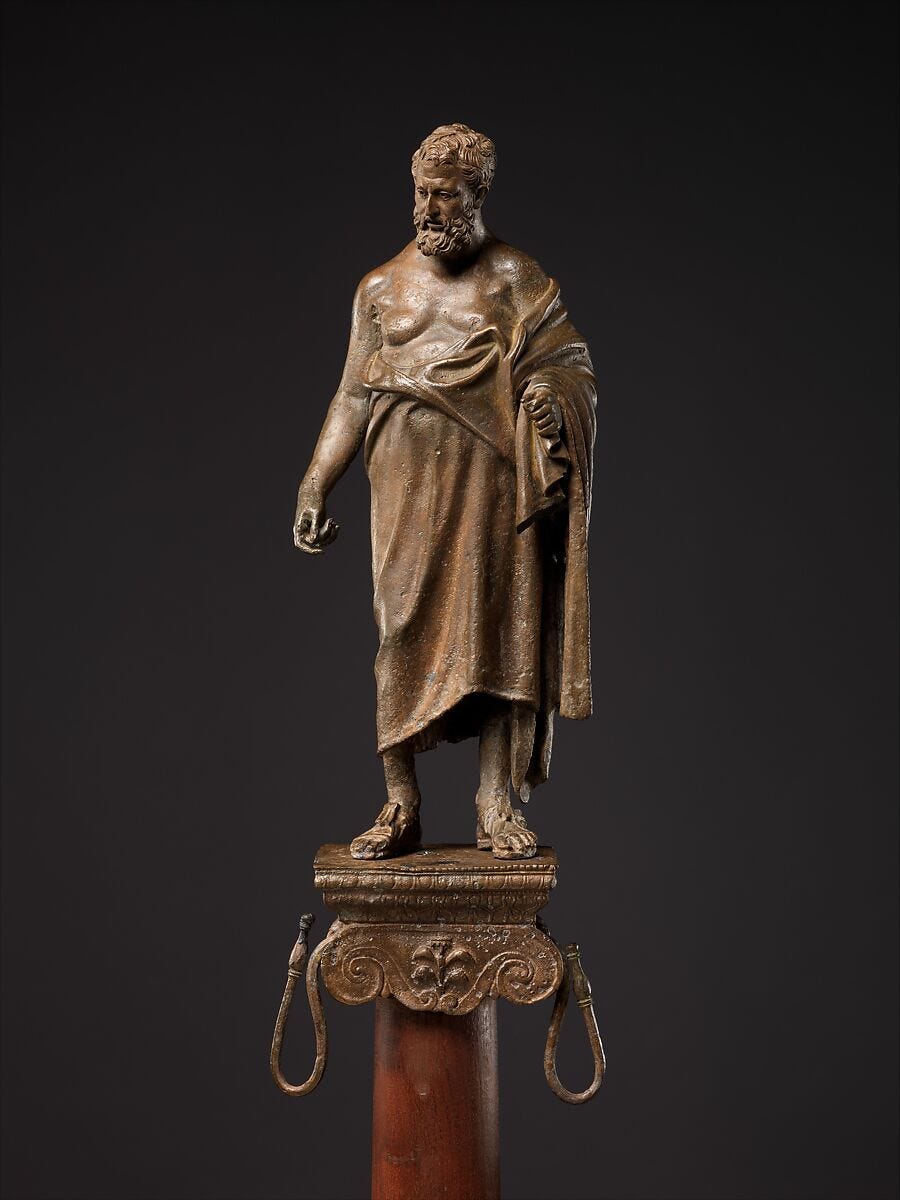
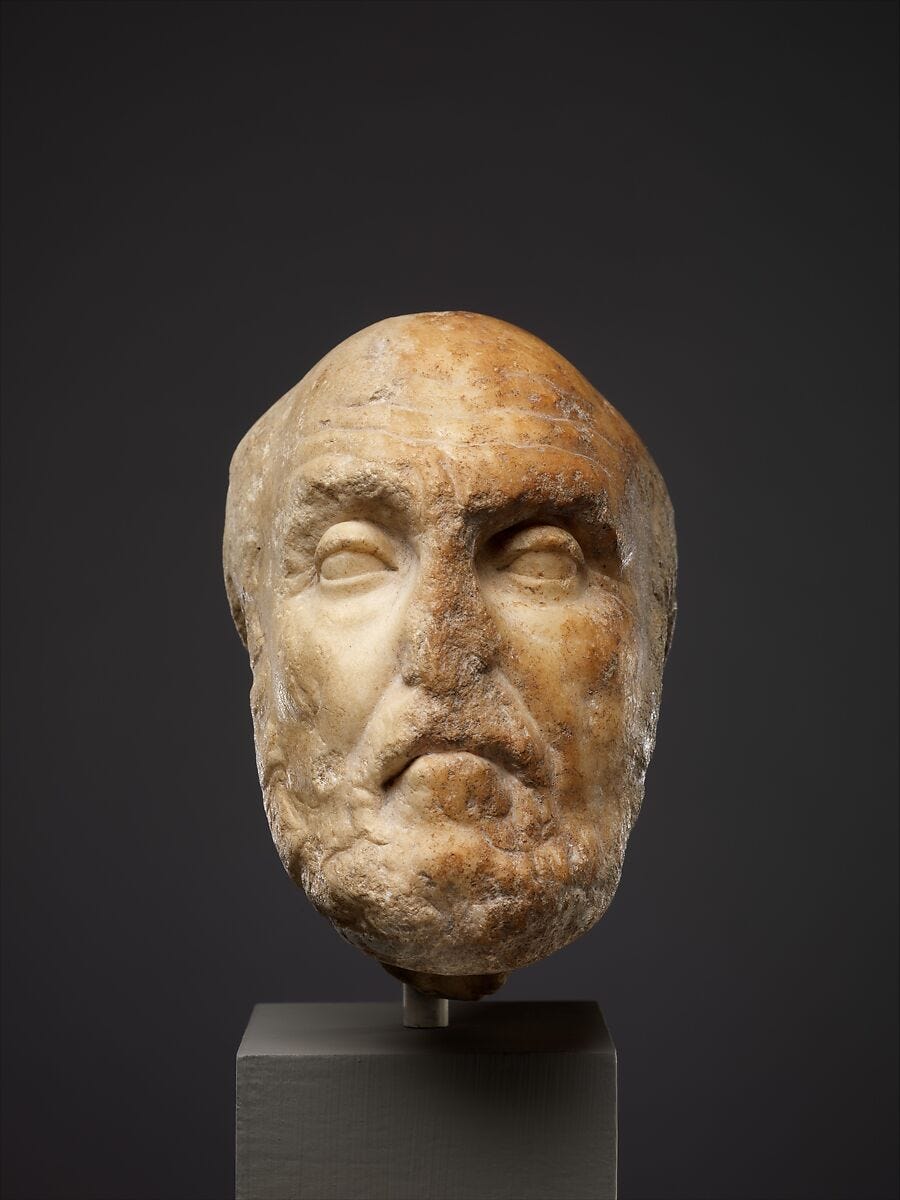
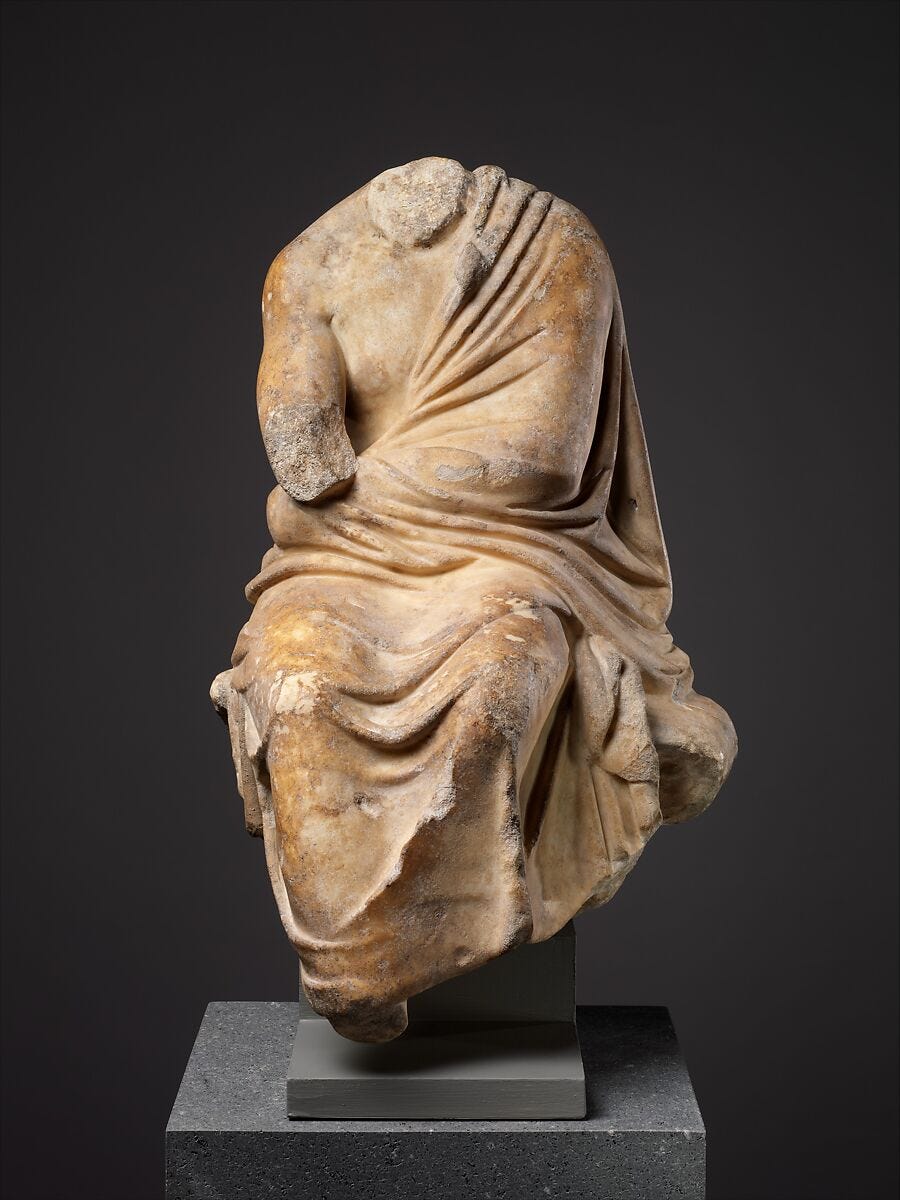
You see this in museums all the time. If you’ve ever looked at a row of classical busts or statues, you’ll probably see some of them vaguely labeled as “Philosopher.” Some philosophers had distinctive facial features—Socrates had a snub nose, for instance, while Epicurus had an aquiline nose and baby bangs—most do not. While scholars cannot usually identify a specific philosopher, they can make a good guess based on a few features:
A long beard, to indicate that the philosopher cares little for style
A cloak, because the philosopher is usually itinerant
A bedraggled look; see 1 above
A frail or even sickly look, because the philosopher cares little for the health of his body; he’s focused on the big ideas instead
In contrast, statesman and emperors are often well-groomed, wearing togas or armor, and (in many cases) signs of old age are minimized to create an idealized look of youthfulness.
The photos accompanying this essay are all from the Met, just to highlight how many unidentifiable/quasi-identifiable philosopher portraits there can be in any one collection.
What I’m getting at here is that the philosopher was, for all intents and purposes, a stereotype. Or, more flatteringly, a myth! He was a myth. Of course the historical figures really existed, but there’s no way to be sure that they led lives that 100% conformed to the stereotypes. I have to say that they probably did not.
The ancients tried to suit philosophers’ biographies to fit their philosophies, interestingly enough. For example, Socrates is almost universally depicted as wandering around, asking people annoying questions, and making them face up to what they do and do not know. Usually, though, things are portrayed in a negative light. For example, Epicureanism haters would lambaste Epicurus for being overly effeminate, weak, immoral, sickly, and so on. Those who disliked Platonism cast Plato as a villain who sought to steal Socrates’ legacy from the likes of Xenophon, a more worthy “heir.” The phenomenon is not limited to philosophers. There is a very long bibliography (part of which I could provide upon request but will not bog us down with here) on Herodotus being a liar because of his fantastical history. There are several other examples as well. Let’s stick to philosophers for the time being, though, just to keep things simple.
I find ChatGPT to be a wonderful mirror of how the philosophical life has become a cultural myth. Ask it what the typical day of a philosopher looks like, and it’ll tell you something like this:
Morning — Contemplation & Alignment
Dawn walk or meditation: Following Aristotle’s habit of walking while thinking, or the Stoic practice of beginning the day with mental preparation (premeditatio malorum — imagining possible challenges and your ideal response).
Reading or recitation: A few lines from Homer, Plato, Epictetus, or even a poem — not for rote study, but as a spark for reflection.
Writing: Short notes to oneself, like Marcus Aurelius’s Meditations — reminders of virtues to cultivate, vices to watch, questions to ponder.
Late Morning — Dialogue & Inquiry
Discussion with peers or students: This is the heart of the philosopher’s work — the Socratic method of questioning and answering, not lectures.
The conversation could take place in a garden, portico, public square, or private study — anywhere that invites exchange.
Rather than rushing to conclusions, they’d linger over definitions, examples, and counterexamples, using disagreement as fuel.
Afternoon — Application & Engagement
Practical duties: Like Aristotle’s involvement in biology or Roman Stoics in politics, the philosopher wouldn’t just theorize — they’d engage with civic, scientific, or artistic life.
Ethical practice: If Cynic, they might perform public acts challenging social norms; if Epicurean, they’d tend their garden and community; if Stoic, they might counsel leaders or arbitrate disputes.
Evening — Review & Gratitude
Philosophical walk or solitary reflection: Reviewing the day — what was done well, where they strayed from their ideals.
Writing letters: Many philosophers (Seneca, Epicurus) wrote to friends far away, sustaining philosophical friendship as a practice.
Simple shared meal: Often modest, in line with their school’s values — bread, olives, fruit, maybe wine — with conversation about virtue, truth, and the nature of the good life.
Night reading: Myth, history, or philosophical texts to let the mind steep in big ideas before sleep.
Key Traits of a Philosopher’s Day
Integration: Philosophy isn’t a 9–5 job but a lens for all moments — eating, walking, conversing, resting.
Balance of solitude and society: Time for personal reflection and time for shared reasoning.
Alignment of theory and action: Living according to one’s conclusions, even when inconvenient.
Moral training: Philosophy as exercise (askēsis), not just knowledge.
Could anyone actually live up to this impossible schedule? Probably not. And yet you probably immediately recognized this as “philosophical” even as you laughed at its dubious realism. But yes! Philosophy is indeed supposed to be a “lens for all moments.”
It all reminds me of how Stoicism is having a revival right now. Resources like the Daily Stoic are wonderful for starting the day out on the right foot, with a passage of reading from a Stoic text and a bit of discussion.
I wish that my studies of philosophy made me more philosophical, though! What really ended up happening is that I became much more interested in philosophical living as a cultural construct or idealized aesthetic, the original way to romanticize your life. I have to say, though, that—as far as I know—the Daily Stoic and other similar things emphasize the emotional regulation aspect of Stoicism while minimizing the crazier cosmological stuff. For example, I don’t really see modern Stoic authors talking about the fact that, according to ancient Stoic thought, the word burned up and then started over every 10,000 years, with events repeating exactly, or something similarly absurd.
Philosophy’s propensity towards stereotype is pretty funny, too. There’s lots of things we could look at here, but let’s just stick to one: second-century author Lucian of Samosata really captures this idea in his satirical work Philosophies for Sale, in which he envisions each philosophical school as a slave put up for sale to a crowd of eager would-be intellectuals. These philosopher-slaves will then mold their new owners into philosophers of that school.
[N.b. All translations are from the 1905 Loeb edition, by H.W. Fowler and F.G. Fowler.]
If you read even a bit, you’ll see how superficially each school is presented:
Fourth Dealer. Zeus! What a difference is here! One of them does nothing but laugh, and the other might be at a funeral; he is all tears.—You there! what is the joke?
Democriteanism. You ask? You and your affairs are all one vast joke.
Fourth Dealer. So! You laugh at us? Our business is a toy?
Democriteanism. It is. There is no taking it seriously. All is vanity. Mere interchange of atoms in an infinite void.
Fourth Dealer. Your vanity is infinite, if you like. Stop that laughing, you rascal.—And you, my poor fellow, what are you crying for? I must see what I can make of you.
Heracliteanism. I am thinking, friend, upon human affairs; and well may I weep and lament, for the doom of all is sealed. Hence my compassion and my sorrow. For the present, I think not of it; but the future!—the future is all bitterness. Conflagration and destruction of the world. I weep to think that nothing abides. All things are whirled together in confusion. Pleasure and pain, knowledge and ignorance, great and small; up and down they go, the playthings of Time.
Fourth Dealer. And what is Time?
Heracliteanism. A child; and plays at draughts and blindman's-bluff.
Fourth Dealer. And men?
Heracliteanism. Are mortal Gods.
Fourth Dealer. And Gods?
Heracliteanism. Immortal men.
Fourth Dealer. So! Conundrums, fellow? Nuts to crack? You are a very oracle for obscurity.
Heracliteanism. Your affairs do not interest me.
Fourth Dealer. No one will be fool enough to bid for you at that rate.
It gets even more ridiculous. Lucian mocks the Stoic view that slavery is not intolerable because it is beyond human control; it’s just a fact of fate for some (admittedly unfortunate) people. The Stoic goes on and on, and the density of his ideas highlights the apparent stupidity of his stance on slavery:
Seventh Dealer. Regard me as your purchaser, good fellow, and tell me all about yourself. I dare say you think it rather hard to be sold for a slave?
Stoicism. Not at all. These things are beyond our control. And what is beyond our control is indifferent.
Seventh Dealer. I don't see how you make that out.
Stoicism. What! Have you yet to learn that of indifferentia some are praeposita and others rejecta?
Seventh Dealer. Still I don't quite see.
Stoicism. No; how should you? You are not familiar with our terms. You lack the comprehensio visi. The earnest student of logic knows this and more than this. He understands the nature of subject, predicate, and contingent, and the distinctions between them.
Naturally, the would-be buyer does not know what a subject, predicate, or contingent is. But by purchasing the Stoic, he can hope to possess the totality of Stoic wisdom. Such is the ridiculous premise of Lucian’s fictional world.
One concluding point I want to make to this is that, if we accept the philosopher as a myth, it does not have to follow that the Romans believed in something that is not real. On the contrary, philosophers were very real to the Romans, and to later cultures (including our own). What does it matter if Socrates or Plato or Epicurus was “philosophical” every minute of every day? The important thing is that they represented a recognizable philosophical ethos or brand to later fans and haters alike.
To look up to a philosopher is to aspire to live one’s own life in a better way, a more organized and less chaotic way, a way that is prestigious in the eyes of others and also deeply personal to the individual. To “be” a philosopher promises belonging even as it marks someone as separate from the rest of society, one who knows what others can’t see. Philosopher status is full of paradoxes: we know it when we see it, but it also defies firm definition. To the spectacle-loving Romans, I think this makes perfect sense. In some ways, philosophy entertained as much as it educated.
I think that this is still true. Picking up on a point I made above, the current cultural revival of Stoicism is a perfect example. People like to follow it in a more or less casual way, not only because it offers hope of a less chaotic life, but also because it allows them to continue the traditions of classical antiquity in some way, however small. It has a storied past, and that’s appealing! It also provides structure to one’s personal development.
What philosophical school would you follow, if you had to pick one? Do you think you could live a stereotypically “philosophical” life? Would you actually want to?
I hope you enjoyed reading this week’s essay! Take care until next time.
MKA
Aristotle, which is not surprising really because I'm a writer and teacher.
Platonist, because like Fox Mulder, "I want to believe."