
Beyond the Beautiful: Exploring Sublimity in Antiquity and Beyond
Encountering sublimity is an experience that brings with it awe, shock, and even terror. From Ancient Rome to Enlightenment Europe and beyond, critics have grappled with what it means to encounter the wondrous.

Have you ever looked at a beautiful sunset, encountered an extraordinary work of art, listened to music that made you cry, or read a passage in a book that you can’t stop thinking about?
If so, you may have experienced what ancient critics referred to as the sublime, an aesthetic experience as profound as it is tricky to define. We all know beauty when we see it—or, rather, when we feel it.
In this week’s essay, we’re going to take a closer look at an ancient text known as On the Sublime, which tries to unpack the particulars of the sublime experience. Ancient ideas about aesthetics and beauty would resonate far into the future, inspiring Romanticism and other artistic/intellectual movements.
On the Sublime is a 1st-century text written by an author whose identity we are not quite sure of. Early manuscripts attribute it to “Dionysius Longinus” or “Dionysius OR Longinus.” Scholars have speculated that the author is Dionysius of Halicarnassus (another literary critic, but the style of the piece makes this less plausible) or Cassius Longinus (also unlikely, because he lived in the 3rd century, and the work does not mention any later literature/authors). Some believe that Dionysius Longinus is the real name, and we just don’t know anything about him, but it could be someone else entirely. For this reason, it’s typical to refer to the author as pseudo-Longinus, indicating that his identity is uncertain.
The text deals with the nature of the sublime, which I like to think of as a step beyond mere beauty. It characterizes something that is not just something aesthetically pleasing: instead, it’s something so marvelous that it stops us in our tracks, sparking awe and wonder. The Greek term for sublimity is τὸ ὕψος (to hupsos), “loftiness” or “elevation.”
Sublimity brings us higher, above the level of the human. This is a fundamental part of its definition (1.3-1.4). The sublime carries with it the power of ekstasis—think of the word “ecstasy,” which is close to what Longinus is talking about. The sublime causes you to basically have an out-of-body experience of awe.
The sublime is pretty much everywhere: in art, in literature, in nature, in everyday life. Longinus is primarily concerned with literature, oratory, and rhetoric as a key source of the sublime. The most key thing is that one’s words create “inspired and vehement passion” in the audience. (8.1-8.2). He gives some hallmarks of creating the sublime, such as ordering one’s sentences and ideas in a rational manner.
Literary criticism and theory can start to sound a little bit scientific, in a way, but the sublime is a tricky thing to capture. It has to hit the audience in just the right way, which means there is an element of sublimity that the author cannot control, precisely. The ultimate effect hinges on the author’s ability to create such vividness that it really sparks the audience’s imagination and mind’s eye (cf. sections 14-15, on the way in which the sublime acts on the audience’s faculty of phantasia, a term that can apply to both an image in the author’s mind and to the resulting vividness he can impart to his audience).
My favorite part of On the Sublime is how Longinus goes through various passages from ancient literature, revealing how their authors created sublimity. He sums it up pretty succinctly: “The sublime is the echo of great-mindedness” (ὕπσος μεγαλοφροσύνης ἀπήχημα, 9.2).
Homer features prominently in the work as a master of creating sublime effect. For example, Longinus writes, it is very sublime when, in the Odyssey, Odysseus goes down to the Underworld and sees his deceased comrade Ajax. But Ajax is not happy to see him, for Odysseus cheated him out of Achilles’ armor. As a result, Ajax refuses to speak to Odysseus, and it is this very silence that makes the scene so sublime.
Certainly not every famous author is sublime, though, or at least not all the time. Longinus also remarks with disgust on an image that is “not just terrible, but actually loathsome” (9.5) that appears in Hesiod’s Shield:
τῆς ἐκ μεν ῥινῶν μύξαι ῥέον.
Mucus dripped out of her nostrils.
Ah, well, nobody can be a perfect writer all the time, even canonical Greek authors.
A similar pitfall is writing in a manner that is overly childlike, illogical, or, as Longinus puts it, “cold.” For example, he cites an author named Timaeus, who wrote an autobiography of Alexander the Great. In so doing, this exemplum of un-sublimity compares Alexander with Isocrates, a grammarian (4.1-2). Unfortunately, it is when we are aiming for loftiness that we often fall short of it, as “our flaws are generally born from the same place as our strengths,” (ἀφ᾽ ὧν γὰρ ἡμῖν τἀγαθά, σχεδὸν ἀπ᾽ αὐτῶν τούτων καὶ τὰ κακὰ γεννᾶσθαι φιλεῖ, 5.1).
Interestingly, while On the Sublime focuses on Greek polytheistic authors, it also briefly cites Genesis (9.9):
In this way also the lawmaker of the Jews, who was not just some regular guy, laid out and made clear quite righteously the power of the divine, when he wrote in the introduction to the Laws, “God said—” What is it that God said? “‘Let there be light’, and there was light; ‘let there be earth,’ and there was earth.”
ταύτῃ καὶ ὁ τῶν Ιουδαίων θεσμοθέτης, οὐχ ὁ τυχὼν ἀνήρ, ἐπειδή τὴν του θείου δύναμιν κατά τὴν ἄξίαν ἐχώρησε κὰξέφηνεν, εὐθὺς ἐν τῇ εἰσβολῇ γράψας τῶν νόμων εἶπεν ὁ Θεός φησί· τί; γενέσθω φῶς, καῖ ἐγένετο· γενέσθω γῆ, καὶ ἐγένετο.
Fascinating, and quite unusual for this era to see polytheistic and monotheistic thought put together! This passage has led some scholars to theorize that Longinus was either a Jew himself, or was otherwise a scholar of Jewish thought.
Intellectuals of the Enlightenment and the Romantic movement were quite taken with the idea of the sublime, in part because some compelling translations of Longinus started to come out.
For example, Edmund Burke’s 1757 work A Philosophical Enquiry into the Origin of Our Ideas of the Sublime and Beautiful directly refers to the idea in the title. According to Burke, beauty and sublimity are related, but not exactly the same; the sublime awes, overwhelms, and even terrifies.
A few decades later, Kant’s Critique of Judgment would argue for the sublime as a thing that shocks us because it reveals the limits of our rational minds, or rather when we become cognizant that there is some greatness in the universe that is above and beyond us. It is limitless and boundless.
Indeed, while Longinus focuses on rhetoric, later critics expanded ideas of the sublime to encompass broader aspects of the human experience. For example, Enlightenment thinker Gotthold Ephraim Lessing took the famous statue Laocoön and His Sons as a starting point to reflect on the limits of painting and poetry. Where ancient poetry might heighten horror through explicit suffering, sculpture achieves sublimity by its restraint, showing pain borne with quiet dignity.
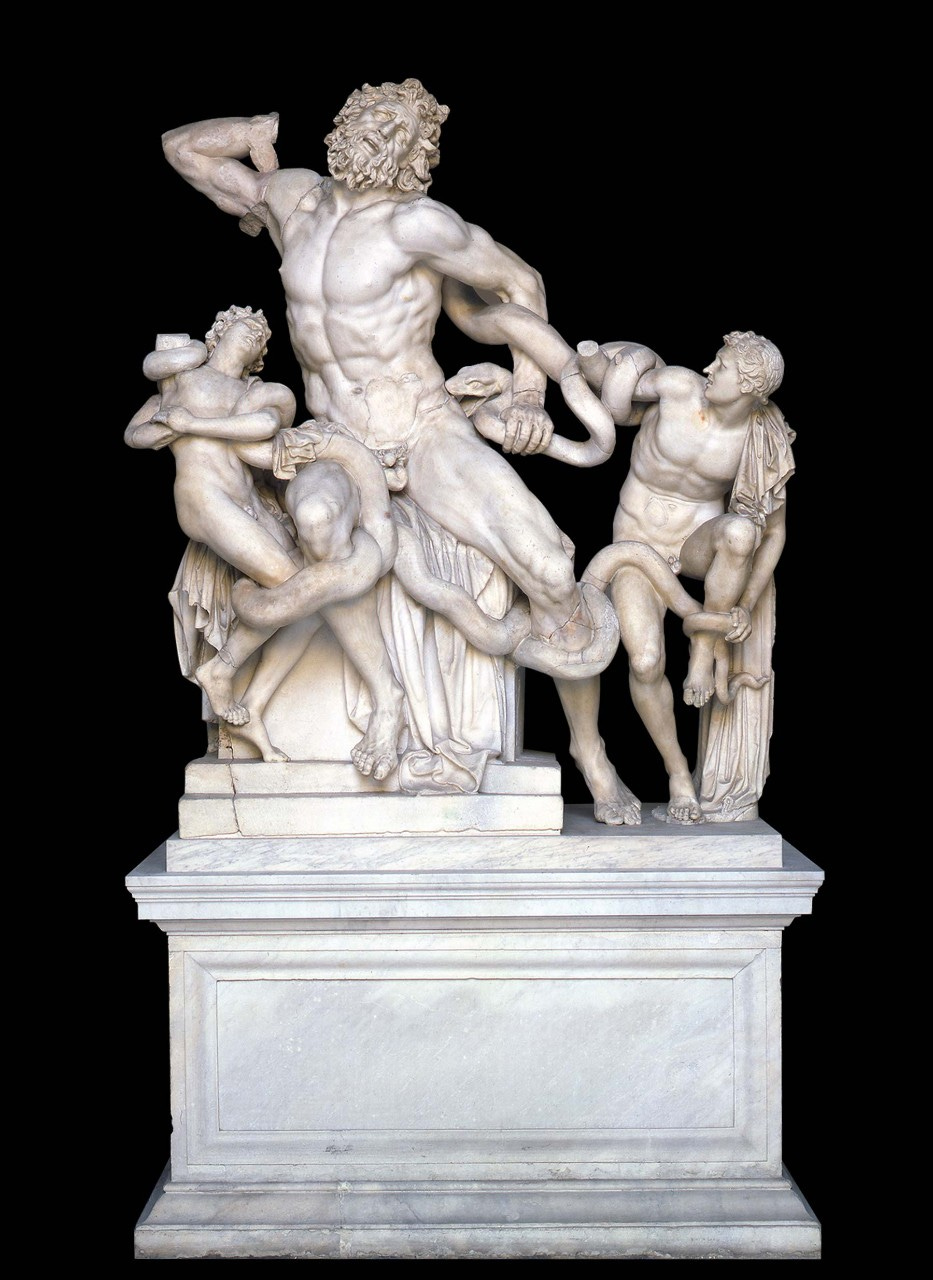
This shows a scene from the Trojan War cycle in which Laocoön, a Trojan priest, finds himself and his sons attacked by sea serpents, a bad omen for the fate of Troy to come. Lessing comments on the seeming emotional restraint of the figures, arguing that sublimity in poetry and sublimity in art require two different techniques. In ancient poetry, for example, this scene is sublime because it overtly highlights the horror of the scene and the suffering of the human figures. In contrast, the statue is sublime because it shows suffering borne with a quiet dignity.
Romantic paintings of the late eighteenth and early nineteenth centuries were also inspired by ideas about sublimity. Take, for example, Caspar David Friedrich’s Wanderer above the Sea of Fog:
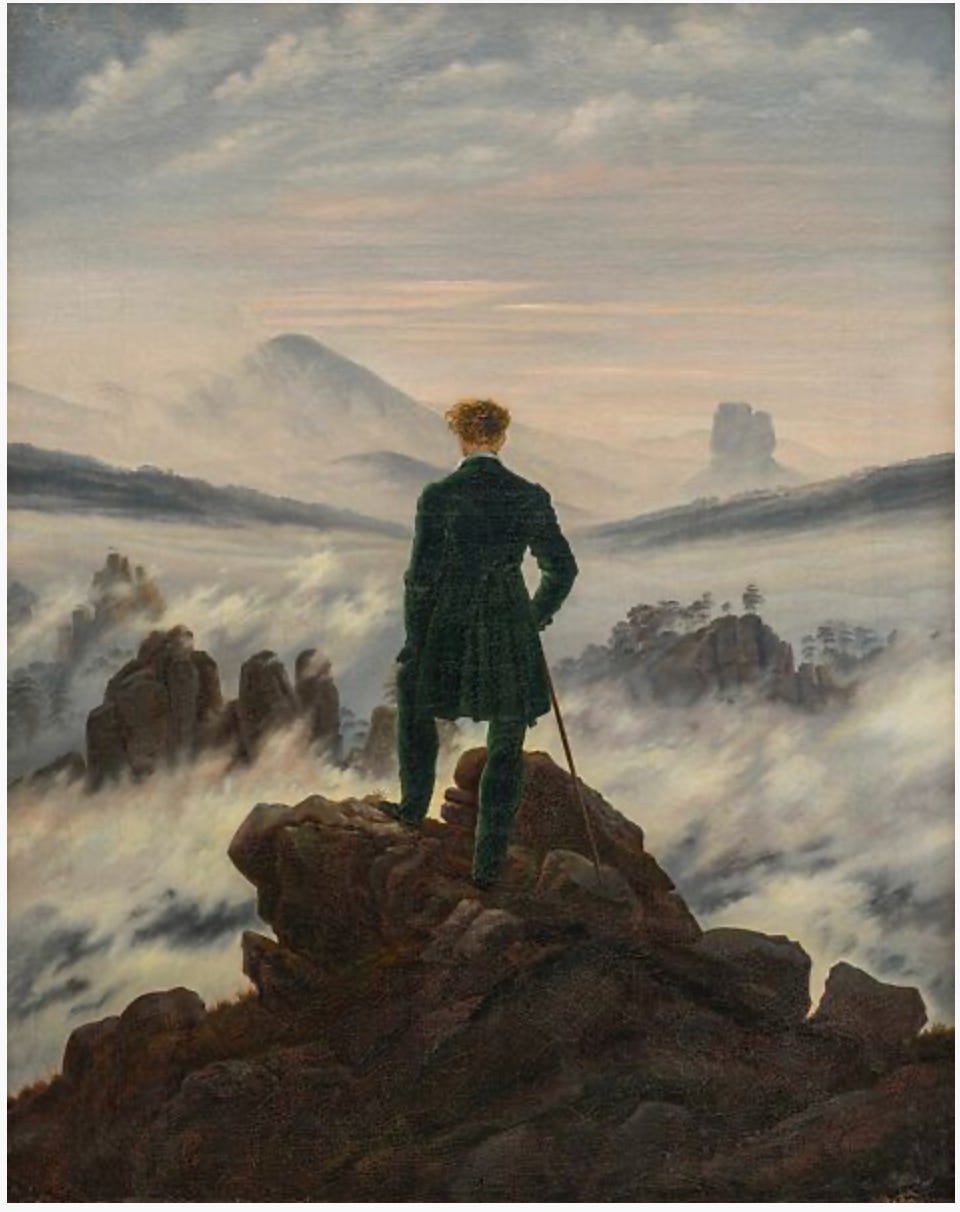
The titular wanderer stands on a rock, gazing out above the fog bank. We cannot see his face, but we can see what he is seeing, while also observing how small he seems against the vastness of nature. This is the sublime: to be an observer of something so much greater than ourselves, and to be aware of that gap.
Similarly, we might see Joseph Mallord William Turner’s Snow Storm: Hannibal and his Army Crossing the Alps as providing another example of the sublime in art:
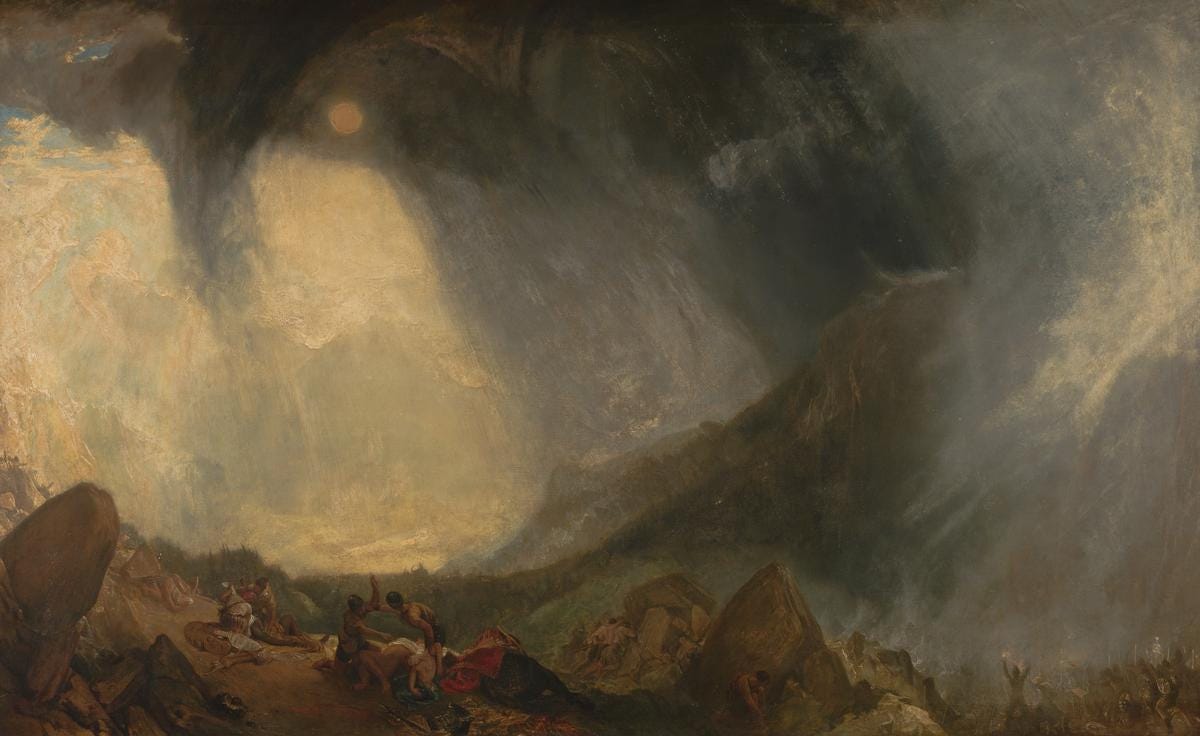
This large painting was originally exhibited at eye level, allowing the viewer to be drawn into the scene. Although it shows a dramatic moment from Roman history, the human figures are overshadowed, literally and figuratively, by the raging storm.
Romanticism, with its emphasis on the grandeur of nature, the depths of human feeling, and the individual experience, can be thought of as a response to the Enlightenment, focused on rationality and science. Yet ideas of the sublime in many ways bridge the two, revealing that they are not quite the polarities to one another that they may seem. Whether you view the sublime as an experience that comes about for rational reasons and rises from certain set principles or as something chaotic and indescribable, the feeling it creates is the same: a strong sense of wonder.
Longinus is such an interesting author! After reading about the sublime, I definitely started to view literature and art in a new way. Ultimately, what makes something sublime or not is highly subjective, and we must rely on ourselves to define it individually. What moves me may not move you, and vice versa! That’s part of what makes it so intriguing as a human experience.
Thank you so much for reading this week’s essay! I hope you enjoyed it. In the comments, I would love to hear your thoughts. What sparks a feeling of sublimity in you? Do you feel a different sense of awe from literature as opposed to art as opposed to nature? What makes a work sublime, or not, in your opinion? Can a sense of the sublime be created intentionally, or is it something more elusive? What contemporary or modern works best capture the sublime, in your opinion?
Take care until next time,
MKA
I adored reading that book, the approximation to Homer is really beautiful. Another text that was such an experience is On Greek Literature by Basil. Different points of view, but absolutely beautiful too.
For me the easiest way to experience the sublime is to look up at the stars at night while at a high altitude in the mountains or in another place of significance. This feeling can be enhanced when combined with music or literature, which is why I find well placed allusions so powerful. I also agree that there is a subtle distinction in feeling between sources of the sublime that is difficult to explain but feels real.