
How to Read an Ancient Text When Most of it is Missing
Classical philology requires a high level of comfort with the unknown, as so many interesting texts are partly or mostly fragmentary.

Classical philology involves a lot of detective work, depending on your genre of study. Whether you view it as an unfortunate reality or an exciting possibility (I’m in the latter camp!), it is a matter of fact that, in many cases, most of an ancient author’s works are entirely lost. Well, not entirely—on many an occasion, we know that an author wrote various works in the first place, which is helpful information to have, because not everyone wrote something. Sometimes we even have a list of the titles of the things they wrote. Even luckier is when you have a line or two or several, some evidence that the text actually did exist at some point in the distant past.
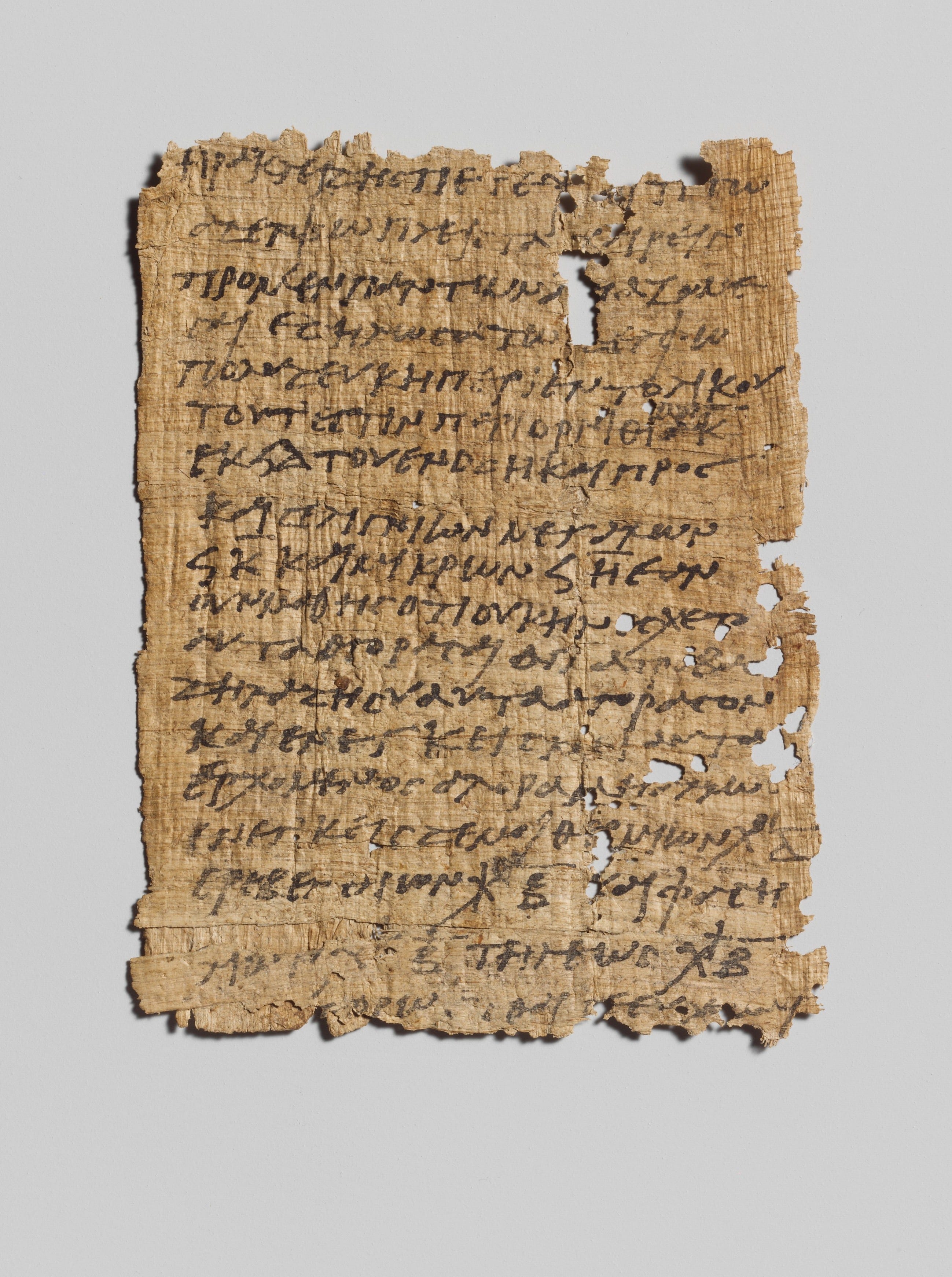
Sometimes this makes things fairly obvious. For example, the title of Aeschylus’ mostly-lost play Phrygians (another name for the Trojans) makes it pretty clear that this has something to do with the Trojan War cycle. The few fragments we have make it even clearer that the play also covered the ransom of Hector, in which King Priam of Troy had to go beseech the Greek hero Achilles to return the body of his beloved son, Hector (Achilles’ nemesis, whom he eventually bested in combat).
We might never have the full edition of the Phrygians, but there’s enough to go on, plus the fragments we do have basically back up our suspicions about the general plot.
Now, there are a few interesting twists here, such as the fact that one of the Phrygians fragments suggests that Achilles—unlike in the Iliad—demanded Hector’s body be weighed out in gold for Priam to pay. But I’d say this is one of the more straightforward examples.
In other instances, though, fragments can be very misleading. One fascinating case study is Menander’s Dyskolos, or, in English, The Misanthrope. Until the mid-twentieth century, this play was known only by its title and a few snippets of dialogue. Scholars spent much time trying to reconstruct the play’s plot.
The facts:
The play is titled The Misanthrope
The play is by Menander, the famous poet of Greek New Comedy, writing in the 4th century BCE. His work is somewhat different than Greek Old Comedy—think of Aristophanes, for example. New Comedy is less overtly political, satirical, and bawdy and tends to focus more on interpersonal dynamics. They’re arguably less funny and more sitcom-like.
There were a few fragments preserved by other, later authors writing down certain quotations.
From this little information, a plot was able to be reconstructed. But when the play was actually discovered hiding in a private collection in 1959, it turned out that the actual plot was quite different than the reconstruction.
This is the danger of relying overmuch on fragments and quotations, as thought-provoking as they can be. Without the full picture, we cannot draw firm conclusions.
At the same time, I’d say—why not try anyway? It didn’t matter, really, that people got the plot of Dyskolos wrong. In fact, it revealed the limitations and possibilities of reading fragmentary work with a critical eye.
And how do we define “fragment,” exactly? Lots of things are fragmentary, when you think about it. Personal letters are just a tiny piece of a larger conversation. Inspirational quotations by famous authors or even soundbites in the media are often devoid of larger context. When we skim instead of thoroughly reading, we fragment the text with our own limited attention span and eagerness to hurry onward.
Even when a text is technically all there, it can still seem fragmentary. For example, maybe an author didn’t explain everything in perfectly clear detail. Or maybe we’re always waiting for the final word. For centuries, fans of Plato have hoped that, one day, we would discover a sort of peak Socratic dialogue called The Philosopher that would finally lay out clearly who and what a philosopher was and provide some closure to well-trodden dialogues The Sophist and The Statesman.
Philosophy is a great example of how works can be both complete and fragmentary. Take, for instance, one of philosophy’s most famous maxims:
You can never stand in the same river twice.
—Heraclitus
The maxim or saying is brief and ambiguous, and yet I think it’s safe to say we have some general idea of what it means, even if the finer points are debatable.
Let’s consider our main question of the day: how do we read an ancient text when most of it is missing? Here’s a series of questions I ask myself when approaching the fragmentary:
Do you know who the author is? Is this a fact, or is it just a spurious attribution?
Do you know when the text was written? If not, are there any clues, such as topic, author, or title?
How much of the text is missing?
Next, you can read the fragments themselves. Ask yourself:
Who compiled these fragments? Where do they come from? How reliable is this source?
What are they about? Are there any recurring themes? Why do you think the excerpter picked them?
Do these fragments seem to come from the same sections of the text, or do they seem to come from disparate portions?
Next, it’s time to be creative.
Is it possible to reconstruct some kind of plot or common thread from these fragments?
Would your opinion change about the work overall if the author attribution was certain? What about if the work is anonymous—does that change your perspective?
If you want to go all out, you can try to fill in the gaps, either missing words or entire phrases. This requires that you know something about composition in an ancient language. It’s easier to do it in the case of individual words, because you can use the size of the gap and also context clues to figure out what word is missing. It is obviously much more difficult if entire swaths of text are gone.
Sometimes it is possible to go through all these steps, sometimes it isn’t! Either way, it’s more about the process than the end result. After all, the odds of uncovering the lost work are extremely low.
We can talk theory all day long, but let’s look at a tangible example of a fragmentary text.
Let’s use Ennius’ Annals, a work composed in the second century BCE that describes early Roman history. It was a very famous and oft-quoted text by later critics, but, of its eighteen books, only some 600 lines survive. This is a snippet of Otto Skutsch’s Oxford Scholarly Edition:
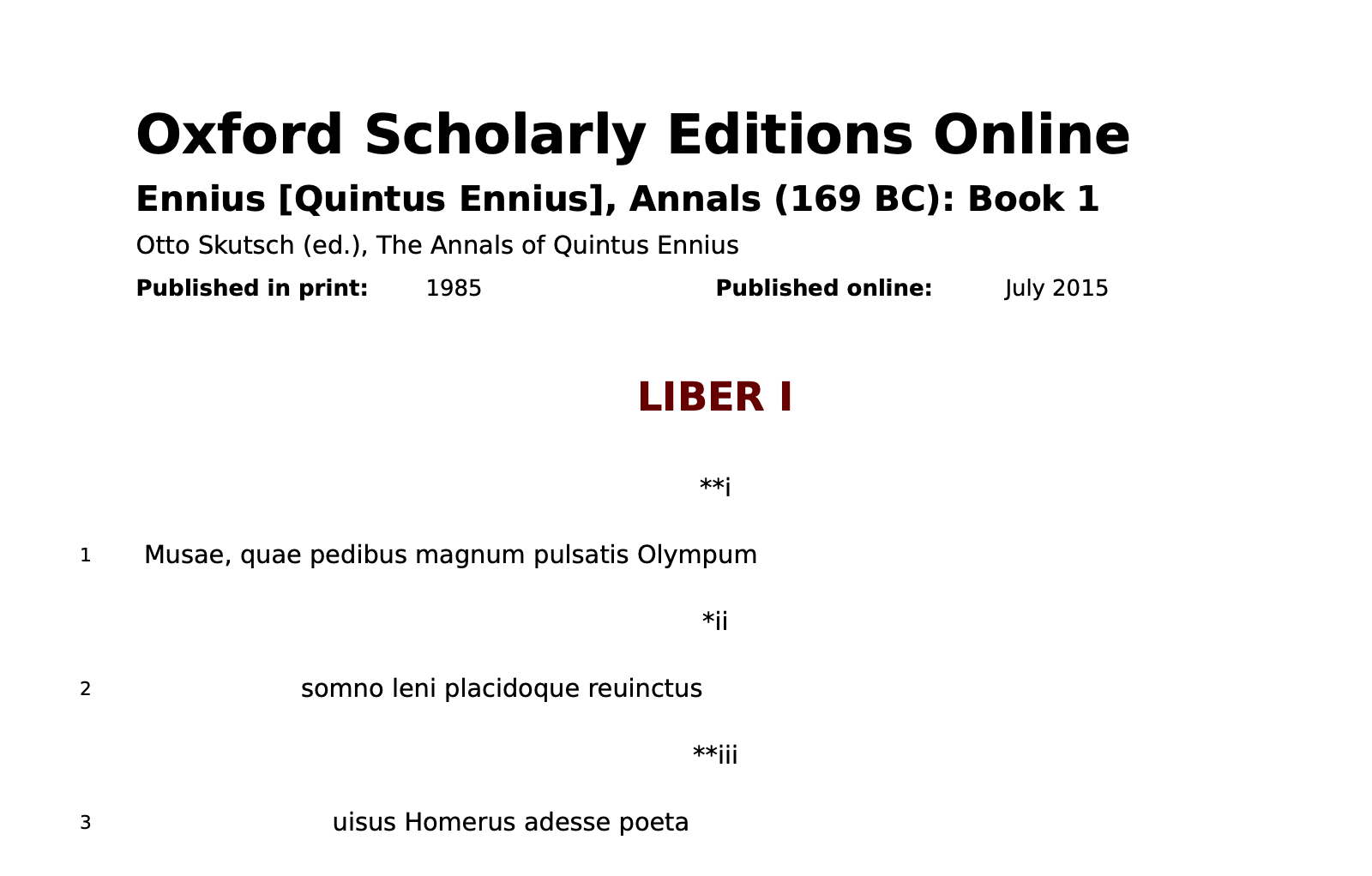
Even if you don’t know any Latin, you can see some of the lines are missing. It reads (my translation):
BOOK 1
Muses, you who shake great Olympus with your feet
[….] bound in gentle and placid sleep
[……..] I dreamed that the poet Homer was there.
We can observe a few things:
There is an invocation to the Muses, which is standard for ancient poetry.
He seems to be having a dream about a meeting with Homer.
Now, this is one of the more commented-upon parts of Ennius by ancient and modern literary critics. We assume that the first line is the actual first line, because ancient poetry often starts out in this way. Also, it would make sense that a dramatic dream sequence goes at the start. The gist is that Ennius allegedly had a dream in which Homer told him that his soul had transmigrated into Ennius. Just some slightly weird clout-chasing, nbd! This is also a spin on the trope of the “dreaming poet.” Archaic Greek poet Hesiod also mentions a dream (not with Homer, who would have been his rough contemporary, but with the Muses), for example.
These fragments, by the way, come from all different places. Otto Skutsch hunted them all down and compiled them into something semi-coherent, which takes a lot of work and diligent thought as to which order the fragments should go in, whether they belong in certain books or not, and so on. So editing a volume like this is no easy feat!
Some parts of a text are more quotable than others, which means that they’re overall better attested, and these fragments are often longer.
For example, Ennius recounts the scene from the life of Rhea Silva, also known as Ilia, who would eventually become pregnant as a result of an encounter with the god Mars and then give birth to Romulus and Remus, the mythical founders of Rome:
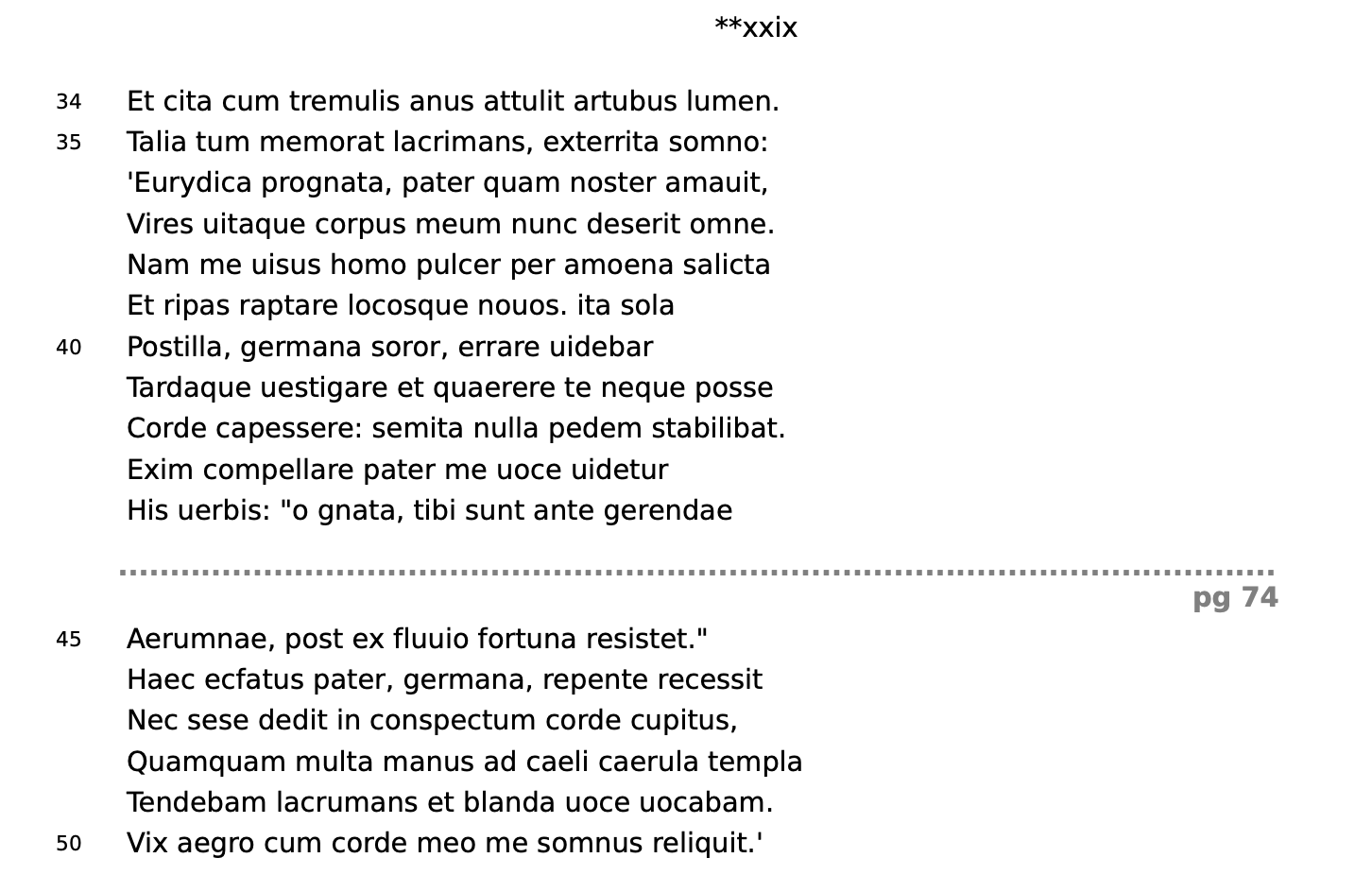
The aged nurse swiftly brought a lamp with trembling limbs. Then [Rhea] tearfully recounted the following things, terrified from sleep: “Daughter of Eurydice, who was our father’s beloved wife, now my strength and life force has deserted my whole body. For I dreamt that a beautiful man [obviously Mars] was dragging me through the pleasant willow-trees and riverbanks and strange places. Then afterwards, my sister, when I was alone, I seemed to wander and, too late, to seek you out and look for you, and I was not able to get ahold of you; no path was stable under my feet. At once my father seemed to call me with his voice, saying these words: ‘Oh daughter, misfortunes will have to be endured by you, but afterwards fortune will fight back.” Having said these things, sister, our father quickly disappeared, nor did he show himself to me, although he desired it in his hearth. Although I repeatedly stretched my hands to the blue realms of the sky, weeping and calling out with a beseeching voice, sleep scarcely left me, being pained in my heart.
It’s a little bit tricky without much context, but the point is that Rhea is telling the story to her sister—whom she poetically addresses as “Eurydice’s daughter.” In this rendition, Ilia (and her sister) seem to be the daughters of Aeneas, but that is not the case in every tradition. Anyway…
To sum up: these events seemed like a dream(? perhaps the rest of the passage would make this more clear), and she doesn’t go into too much detail. But in fact her meeting with Mars was real, and she would indeed go on to become pregnant with the famous twins. It was a difficult situation for an unmarried woman, but she would eventually gain eternal glory as the mother of such heroic figures.
This longer fragment gives us a good indication of the rest of the narrative, but it’s really only a tiny glimpse of the lost whole.
You might be wondering why so much of the text is lost if Ennius was so famous. I’m afraid it’s an unpredictable combination of 1) People taking the time (or not) to excerpt or quote him in their own works 2) The interests of monks and various other scribes copying down ancient texts and 3) The availability of those texts once copied down. Remember, most ancient manuscripts have not survived—much of what we have is from the medieval period and later.
To return to our original query: how do we read an ancient text when most of it is missing? Well, you read it and you don’t, so to speak. You see what’s there, you use your imagination and informed hypotheses to fill in the rest, and hope that maybe one day the complete text will be found in some library or private collection to prove you right or wrong. It’s an activity that, by its nature, has no real closure—which means that your relationship with the text is perpetually open-ended.
Do you think you’d enjoy reading fragmentary literature, or would you just find it frustrating? If you like a good mystery, it’s fun to dive in and see what you can find. I hope you enjoyed this brief taste of what it’s like to work with fragmentary texts! Take care until next time.
MKA
I enjoyed this! I often work with inscriptions that are fragmented. It’s nice to see this topic discussed in longer literature too.
I spent a sizable chunk of my life with Greek lyric poets, so fragments look so familiar to me that I'd be surprised not to see [. . .] . [. in my texts...
Often fragments allow otherwise serious and boring scholars to transmogrify themselves into poets, the blanks giving room to imagination. Think of D.L.Page integrations to most Greek lyrics...